
Welcome to Week 1 of Camp Runamuck, campers.
This week, our theme is Pack Your Provisions, and we are focusing on pre-workout fuel, post-workout recovery, and hydration. Basically, we are making sure you are not asking your body to run, walk, ride, lift, hike, or sparkle-shuffle through June on coffee, vibes, and one heroic sip of water. I say that with love, because many active women are doing a lot with very little fuel in the tank. Then we wonder why the workout feels harder, the recovery feels slower, and the afternoon energy crash rolls in like a camp raccoon looking for unattended snacks.
This week is not about complicated meal plans or turning every bite into a math problem. It is about adding support before you ask your body to perform. It is about noticing what helps you feel steady, strong, hydrated, and better prepared for movement. It is about learning that a small carb before a workout, a simple post-workout recovery snack, or a smarter hydration rhythm can make a real difference in how you feel. Think of this as packing your trail bag before the hike instead of wandering into the woods with nothing but optimism and lip balm.
Why Morning Fuel Matters, Especially for Midlife Women
For many women, especially those navigating perimenopause and postmenopause, morning workouts can feel different than they used to. Hormonal shifts can affect sleep, recovery, stress response, body composition, energy, appetite, and how hard workouts feel. Add heat, humidity, summer schedules, and under-fueling to the mix, and suddenly that “easy” morning workout may feel like you are dragging a canoe uphill. If that sounds familiar, you are not broken. Your body may simply be asking for more thoughtful support.
Dr. Stacy Sims has been one of the leading voices encouraging active women, especially midlife women, to reconsider fasted training and under-fueling. Her work often emphasizes that women are not small men, and that female athletes may respond better when they train in a fed state, particularly when intensity, strength, or longer endurance efforts are involved. One of her commonly discussed points is that eating in the morning, especially protein and/or carbohydrate depending on the workout, can help support energy availability and may help reduce the added stress of training on an empty tank. That does not mean every person needs the same breakfast or that one snack solves everything, but it does invite a really useful question: “Am I asking my body to do hard things without giving it anything to work with?”
This is especially important if your morning routine looks like coffee, workout, more coffee, then maybe food several hours later. Caffeine is lovely, and I am not here to fight your latte, cause I haven’t met a coffee that I didn’t love. But caffeine is not breakfast, and it is not a full fueling strategy. If you are walking gently for 15 minutes, you may not need much. If you are running, doing intervals, strength training, riding, or heading out in heat and humidity, your body may appreciate a little something before you begin.
That “little something” does not need to be fancy. It could be half a banana, toast with honey, applesauce, dates, a small granola bar, a few crackers, or a sports drink if that sits better before early movement. If you have more time before your workout, you may add a bit of protein, like Greek yogurt, a small smoothie, cottage cheese, or protein coffee. The goal is not to force a huge meal if your stomach is not ready. The goal is to stop assuming that empty is automatically better.
What to Eat Before a Workout
Pre-workout fueling is mostly about giving your body accessible energy. For many workouts, especially running, walking, cycling, hiking, rowing, or strength sessions, carbohydrates are your friend. Yes, friend. Not villain. Not something hiding in the camp woods. Carbohydrates help support blood glucose, energy, and performance, especially when your workout is longer, harder, or happening in warm conditions.
A simple guideline is to aim for around 15 to 30 grams of carbohydrates if you are eating about 30 to 60 minutes before movement. If you have 60 to 90 minutes, you may feel better with closer to 30 to 60 grams of carbohydrates, and possibly 5 to 15 grams of protein, depending on your tolerance and the type of workout. Keep fat and fiber a bit lower right before harder workouts because they slow digestion and may not feel great if you are running or moving with intensity. We love fiber, but we do not need her riding shotgun during speed work.
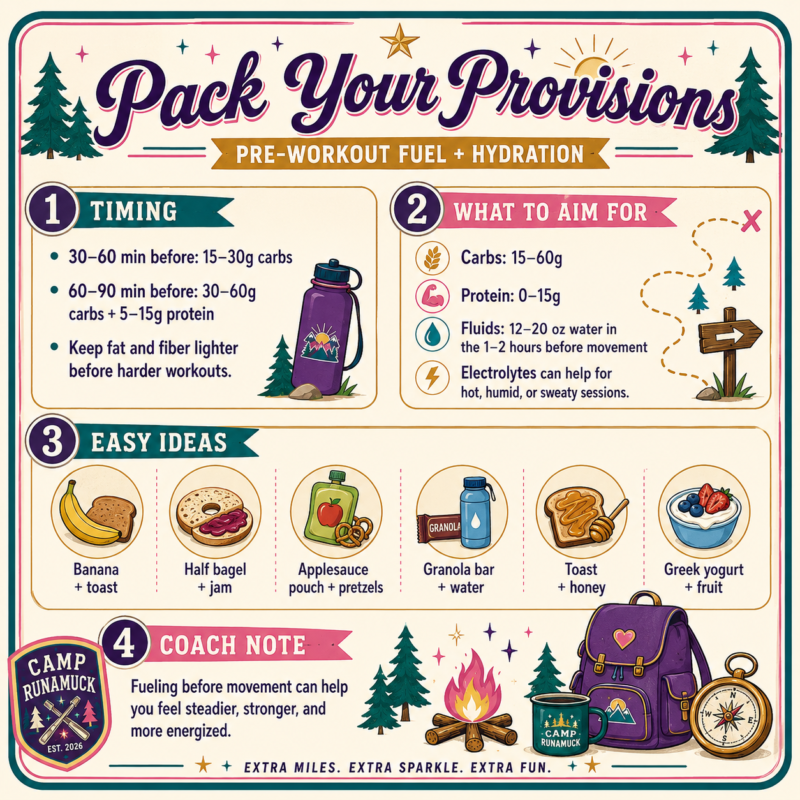
Easy pre-workout ideas include banana and toast, a half bagel with jam, applesauce and pretzels, a granola bar and water, toast with honey, or Greek yogurt with fruit if you have more time. Some people do well with liquid options like a small smoothie or sports drink, especially if early morning solid food feels like a hard no. This is where experimentation matters. Your perfect pre-workout snack is not the one that looks best on Instagram. It is the one that helps you feel energized, steady, and not like your stomach is filing a formal complaint.
For lower-intensity movement, like an easy walk or gentle mobility, you may not need much. But if you notice dizziness, shakiness, unusually high effort, crankiness, headaches, or a big energy dip later, it is worth testing whether a small pre-workout snack helps. This is not about eating because a rule told you to. This is about gathering feedback from your own body like the wise camp counselor you are becoming.
Hydration: The Provision You Need Before You Feel Thirsty
Hydration is one of those things that sounds basic until summer shows up and suddenly your body is sweating like it has joined a competitive sprinkler league. In warm and humid weather, hydration is not just about comfort. It can affect how hard movement feels, how well you regulate temperature, your energy, your mood, your digestion, and your recovery. If you start a workout already under-hydrated, everything may feel harder than it needs to.
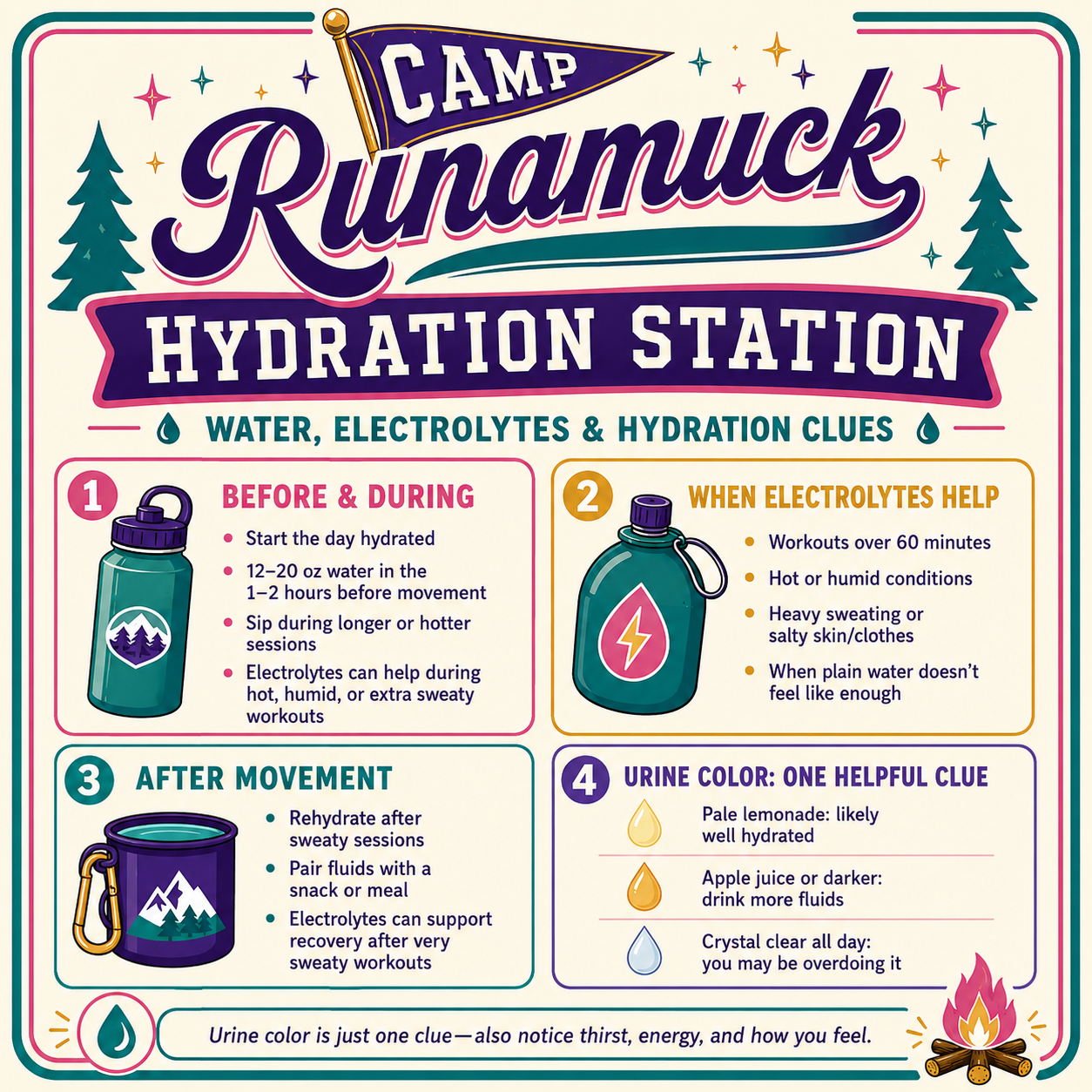
A practical goal is to drink water consistently earlier in the day rather than trying to chug a heroic amount right before you head out. For many people, 12 to 20 ounces of water in the 1 to 2 hours before movement can be a helpful starting point. During longer, hotter, or sweatier sessions, sipping fluids during movement may also help. After movement, especially sweaty movement, rehydrating matters too.
Electrolytes can be useful when you are exercising in hot or humid conditions, sweating heavily, working out for longer than an hour, noticing salt on your skin or clothes, or feeling like plain water is not quite cutting it. Electrolytes help replace sodium and other minerals lost in sweat, and sodium can help the body retain fluid more effectively. You do not need electrolytes for every sip of water all day long, but they can be a great tool when heat, sweat, duration, or intensity increase.
Urine color and output can offer one clue about hydration, but it is not the whole report card. Pale lemonade color can suggest you are generally hydrated. Darker apple juice color may be a sign to drink more fluids. If your urine is crystal clear all day and you are constantly running to the bathroom, you may be overdoing plain water without enough electrolytes or balance. Also pay attention to thirst, energy, dizziness, headaches, sweat rate, heat exposure, and how you feel overall. Your body gives more than one signal, and we are learning to listen to the whole camp radio, not just one channel.
What to Eat After a Workout
Post-workout fuel is your recovery campfire. It helps replenish energy, support muscle repair, and prepare your body for the next adventure. This matters even more if you are training consistently, doing strength work, running or walking frequently, exercising in heat, or trying to support muscle and recovery through perimenopause and postmenopause. Your body is not being needy. It is doing repair work, and repair work requires supplies.
A useful post-workout target is often around 20 to 30 grams of protein plus 30 to 60 grams of carbohydrates, especially after longer, harder, or sweatier workouts. Some midlife women may benefit from aiming higher with protein across the day, particularly if they are strength training or working on muscle maintenance, but the best amount depends on body size, training load, health status, and total daily intake. The big picture is this: protein helps support muscle repair, and carbohydrates help replenish glycogen, which is your stored carbohydrate energy. Together, they make a great recovery duo.
Timing does not have to be panic-level precise, but after harder or longer workouts, getting recovery fuel within 30 to 60 minutes can be helpful. After easier sessions, eating within 1 to 2 hours may be perfectly fine, especially if your next meal is soon. This is another place where context matters. If you finish a long run, strength workout, hot ride, or sweaty hike and then wait four hours to eat, your recovery may not feel fantastic. If you finish an easy 20-minute walk right before lunch, your regular meal may do the job beautifully.
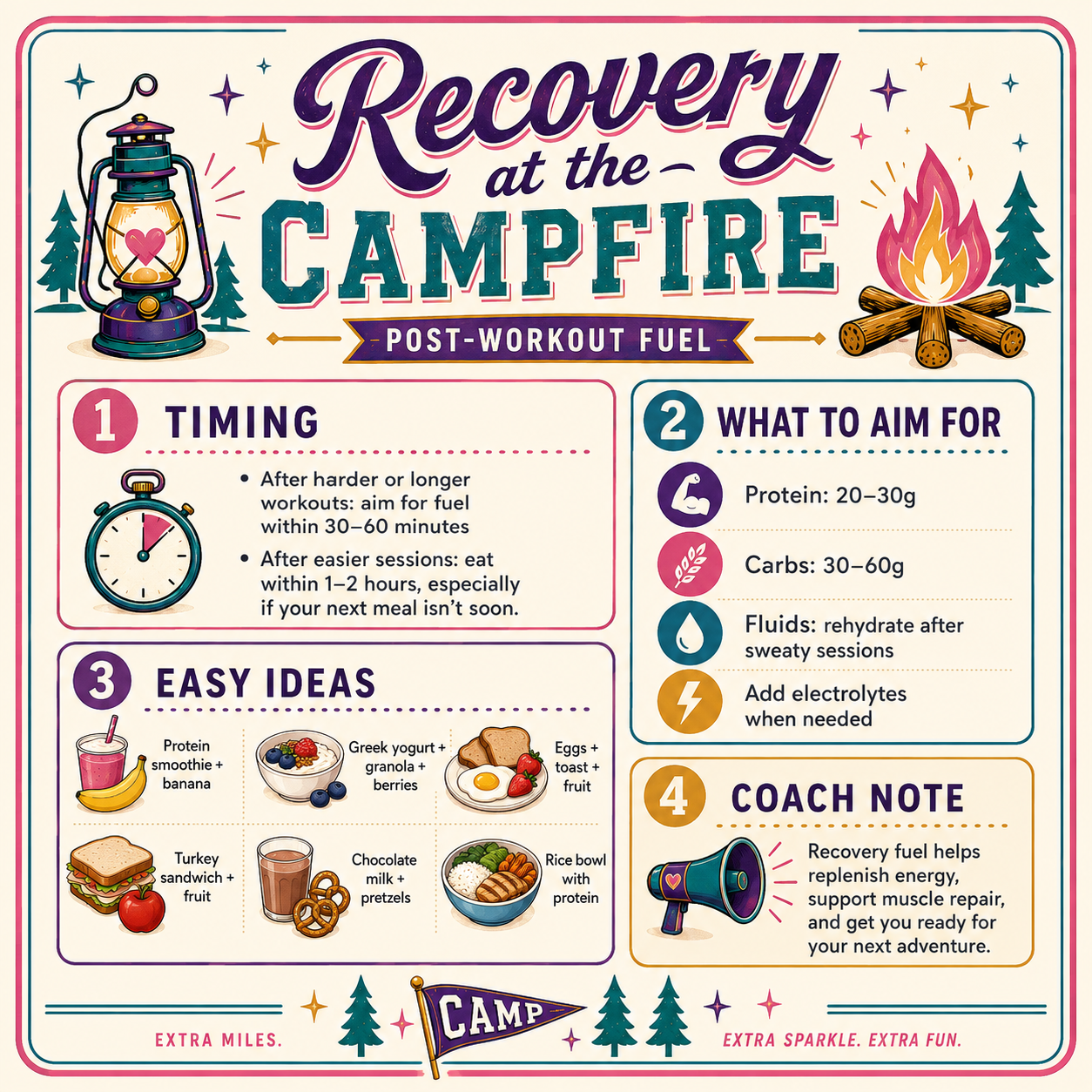
Post-workout ideas can be simple: a protein smoothie with banana, Greek yogurt with granola and berries, eggs with toast and fruit, a turkey sandwich with fruit, chocolate milk and pretzels, a rice bowl with protein, cottage cheese with fruit, tofu scramble with toast, or leftovers that include protein and carbs. This does not need to be gourmet. Camp food can be practical. The goal is to make recovery easy enough that future-you does not have to negotiate while sweaty and hungry.
The Camp Runamuck Way: Add Support, Do Not Add Shame
Here is the heart of this week: we are not using nutrition as punishment. We are not earning food with movement, and we are not turning hydration into a moral achievement. We are practicing how to support our bodies before and after movement so that we can feel better, recover better, and keep showing up.
This is especially important for women who have spent years hearing that smaller, lighter, less, and “just push through” are the answers. Sometimes the more powerful answer is actually: eat earlier, hydrate sooner, add protein, add carbs around training, recover on purpose, and stop making your body prove it can do everything under-fueled. That is not indulgent. That is smart training.
Try one small thing at a time. Maybe you try a small carb before your morning walk or run. Maybe you drink water before coffee. Maybe you add electrolytes before a sweaty workout. Maybe you prep a post-workout breakfast so you are not trying to make decisions while standing in the kitchen like a damp, hungry camp ghost. Pick one support and pay attention to what changes.
You are not trying to become perfect at fueling in seven days. You are learning your body’s clues. You are collecting information. You are building a relationship with what helps you feel steady, strong, energized, and ready to move with intention.
Coach Christine’s Challenge
This week, before one workout, ask yourself:
What provision would help me feel more supported today?
Then choose one:
A small carb before movement
Water earlier in the day
Electrolytes for a hot or sweaty session
A post-workout protein and carb snack
A breakfast that is ready when you finish
A water bottle packed before errands or outdoor movement
Afterward, notice how you feel. Not perfectly. Not scientifically. Just honestly.
Did your energy feel steadier?
Did your workout feel less draining?
Did you recover better?
Did you avoid the post-workout snack attack?
Did your afternoon feel less chaotic?
Did your body seem to appreciate the support?
That is the work this week. Not restriction. Not perfection. Not a spreadsheet with a whistle. Just support, curiosity, and a little camp sparkle.
Before you hit the trail, pack your provisions.